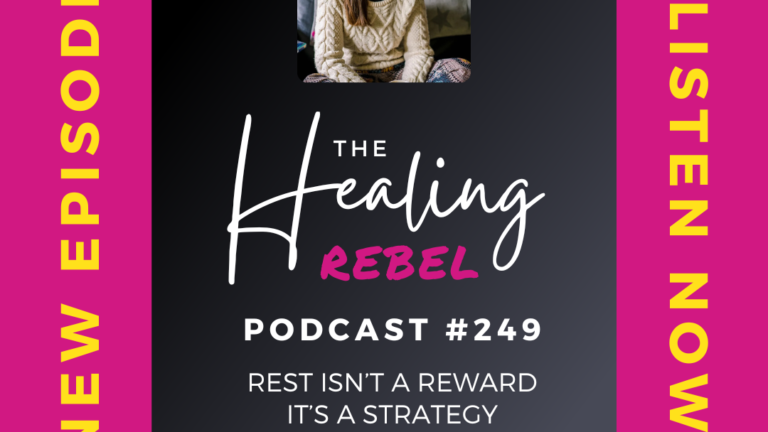
How to Build Rest Into Your Business and Life
Published: 17th July 2026 | The Healing Rebel Podcast, Episode 249
“I don’t know how I’m still alive. My burnout has burned out.”
That was a message from a client of mine recently. It stopped me in my tracks, because I’ve been that client. Not that exact wording, maybe, but the same underlying state. Running on empty, still going, still saying yes, still telling myself I could hold it all together for just a bit longer.
I’m Jen Wilson, The Healing Rebel, and this episode is about why rest needs to be part of your actual strategy in business and in life, not something you do when everything else is finished. Because it never will be finished. And if you wait until you have time, you’ll never have time.
Listen on your favourite platform:
[Spotify] [Apple Podcasts] [Amazon Music]
What this episode is about
I’ve been self-employed since July 2010. That’s 16 years, and I have got this one very wrong for most of them.
When I first started out, my coaches told me the same thing they tell everyone: build the life you want first. Know the days you want to work and the schedule you want to keep. Block off the rest of the time for your business, for rest, for yourself.
I didn’t listen. I said, “I love what I do, so I’m never working another day in my life.” And I meant it. I did love it. I still do. But loving what you do doesn’t exempt you from needing rest.
That’s the piece I want to get into.
Loving your work isn’t a rest strategy
If you’re in the wellbeing industry, the creative industry, or any work that feels meaningful to you, this trap is particularly sneaky. Your work feels like play. You’re doing the thing you’d do anyway. So it doesn’t count, right?
Except it does. Because it’s still your business. Still your income. Still your responsibility. And if you’re thinking about it from the moment you wake up to the moment you fall asleep, you’re never giving that part of your brain and nervous system a chance to switch off.
Think of your car. If you only ever put petrol in, never check the oil, never check the tyres, never book it in for its MOT and service, the car will pack in. The battery will die. The engine will burn out.
Your body is the same, except more complex. Yes, humans can now get new legs, new arms, new organs. But those are enormous ordeals. If you can strategise rest into your life properly, you avoid the burnout that gets you to the point of needing that level of intervention.
The 10 years I worked without a proper break
For the first 10 years of my self-employment, I worked seven days a week. Not nine to five, either. Some days I’d start at 7am and finish at 9pm. Some nights I’d work on my business from 10pm until midnight because that was the only quiet time.
I had holidays to Ibiza that I called breaks, but I was partying hard, so those weren’t rest either.
There was no proper downtime. My sleep was poor. My rest was poor. Everything was poor except the volume of work I was getting through.
In 2020, I finally started introducing scheduled downtime into my calendar. Weeks where I closed the diary and didn’t take clients. And it took me a couple of years of doing that consistently before I could actually switch off during those weeks.
It’s only in the last year that I’ve genuinely got to a place where, on my day off, I don’t take the phone with all my social media and work on it. I take my other phone. I go to my mum’s, I go for a walk, I do the thing without the constant background hum of “should I be working right now?”
That took years to build. Years. Not because I’m slow, but because I’d trained my nervous system for more than a decade to be permanently switched on. Undoing that is a proper piece of work.
What rest looks like for you might not be what it looks like for me
There’s no universal right answer to what rest is. For one person, rest is raving and dancing and having a blast. For another, it’s walking in a forest. For another, it’s lying down with a book.
The work is finding out what rest actually looks and feels like for you.
If you’ve spent years living and breathing your business, this will take practice. You might feel guilty at first. You might not know what to do with yourself. You might find yourself picking up the phone out of habit and having to consciously put it down again.
If your work is creative and you love creating, ask yourself what you can do that’s creative but where you’re not the one leading. Take an art class instead of teaching one. Go to someone else’s meditation group. Attend the workshop rather than facilitating it. Be the one receiving, not the one holding space.
That distinction is enormous. Being the person receiving the energy of a room is very different from being the person creating and holding it.
Pre-scheduling is the whole game
Right now, in July 2026, I’ve already scheduled my downtime for the start of 2027. I know when my April retreat is. I know I want the week after it off. I plan my events, my launches, and my client work around those blocks of rest, not the other way around.
I also plan around school holidays. I’m not a parent, but I know that if I put my downtime during school holidays, my nervous system will feel the shift because everyone else is off too. I want my downtime to be genuinely mine, so I slot it into the quieter windows.
Pre-scheduling matters because if you wait until you feel you deserve a break, you won’t take one. Something will always be more urgent. The break gets pushed and pushed until your body forces it on you through illness, exhaustion, or a full collapse.
Put the rest in the diary first. Then plan around it.
Holidays where you’re still working aren’t holidays
If you’re going on holiday and spending a couple of hours a day on emails, you’re not on holiday. You’re working in a different location.
You’re missing the point of the change of scene. You’re missing the new experiences. You’re not giving your nervous system what it actually needs, which is the full permission to be somewhere else and not be responsible for anything.
You’re also modelling something to the people you’re with. If you step away from your family to send emails, what message does that send about where they sit in your list of priorities?
Nothing I do is life or death. Nothing. If an email doesn’t get answered for a few days, it’ll get answered when I get back. That’s true for me and it’s true for most of us, though it can take a while to accept.
Practical tools that make time off actually work: pre-schedule your social media posts so content still goes out. Pre-schedule your emails and newsletters. Set up an out-of-office reply that tells people when you’re back and points them somewhere useful if it’s genuinely urgent. Have someone check your inbox if you need real cover.
Your nervous system is a dance, not a settlement
Your autonomic nervous system has two main branches. Sympathetic is your fight or flight, but it’s also your action, your get-things-done, your drive. Parasympathetic is your rest and digest, but it’s also your healing, and sometimes your inability to take action.
One isn’t better than the other. Both are vital. The dance between them is what matters.
The problem is that many of us in business have spent so long in sympathetic drive that we’ve forgotten what parasympathetic feels like. We’re validated. We’re needed. We’re wanted. We have this heightened state and it feels like being alive.
But when you get into that parasympathetic state, that’s where the play happens. That’s where clarity comes. That’s where your best ideas surface. Not while you’re grinding at the desk at 10pm, but when you’re walking, resting, or doing something that lets your brain settle.
Your best ideas come when you stop
This is one of the reasons I always keep a note-taker with me. A pen and paper, an app on my phone, something. Because ideas surface when I’m not looking for them. On a walk. In the shower. Making dinner. Lying down.
The old me would have jumped up and started building the idea immediately. Setting up the website, drafting the launch, planning the whole thing at 11pm.
Now I write it down and leave it. Because if it’s a genuinely good idea, it’ll still be a good idea in 24 or 48 hours, when I’ve rested properly and can look at it with clearer eyes. Half the time, I come back to the idea and see it needed refining. The other half, I’m glad I didn’t rush in and build something I’d have had to unpick a week later.
Rest doesn’t just protect your energy. It protects the quality of your decisions.
The dopamine trap
There’s something else worth naming. When you get positive feedback on your work, you get a hit of dopamine. That feels great. You feel valuable, needed, appreciated.
The problem is dopamine isn’t meant to be a constant. It’s meant to happen when good things happen. When you chase it, whether through social media scrolling, work validation, or constant productivity, you desensitise yourself to the smaller, slower forms of satisfaction.
The dopamine that comes from spending quality time with people you love is quieter and slower than the hit of a great review. A day out with someone who matters is a more sustained satisfaction than a validating message from a client.
If you’re stuck in the loop of chasing intense dopamine hits from your work, you’ll struggle to find satisfaction in the slower, deeper things. Rest isn’t just about the body. It’s about resetting your relationship with what actually makes you feel alive.
Values, and why they change everything
I wrote about values in my book 9 Rules to Sort Your Shit, which is 10 years old this year. What I said then still stands.
Ask yourself: what are your life values? Your career values? Your relationship values? Your money values?
Then look at them together. Do any of them conflict? If your relationship values are trust, honesty, and presence, and your career values are freedom, success, and authority, where do they gel and where do they clash?
Your rest strategy comes out of your values. If freedom is a top value for you, but you’re working 60 hours a week and never taking real time off, your business has hijacked one of the things you most want out of life. That’s worth noticing.
When there’s a lot going on outside work
If you’re navigating a big life season, kids, moving house, health issues, sick parents, a career change, your nervous system is already carrying significant load. That’s when rest becomes essential, not optional.
The client I mentioned earlier, the one who said her burnout had burned out, was going through exactly that kind of season. Multiple plates. A job. Family stuff. When she finally came in for an hour with me to lie down and be held in space, her whole system exhaled.
You don’t have to be in crisis to make that kind of time for yourself. But if you are in that kind of season, the rest isn’t a luxury. It’s the thing that lets you keep going without becoming your next chronic illness statistic.
The point
Rest doesn’t happen by accident. It doesn’t happen when things quieten down. It doesn’t happen when you deserve it.
It happens when you put it in the diary and treat it as non-negotiable as any client appointment or business commitment. Because if it isn’t, everything else will fill the space and there won’t be any left.
The women I work with tell me all the time when they walk in that they finally feel like they can breathe. That’s what a proper reset does. It gives your nervous system permission to exhale. And once it’s had one proper exhale, it starts remembering it’s allowed to keep doing that.
You don’t have to come to me. Come to someone. Do something. Book something. Just don’t wait until you’ve got time. That time isn’t coming unless you make it.
Frequently asked questions
Why is rest important for business owners?
Rest allows your nervous system to move between sympathetic drive (action) and parasympathetic state (recovery, creativity, clarity). Without regular rest, business owners get stuck in constant activation, which leads to burnout, chronic illness, and poor decision-making. Rest isn’t a reward for hard work. It’s part of how you sustain the work.
How do you actually take a proper holiday when you’re self-employed?
Pre-schedule your social media content. Set up an out-of-office reply. If your business genuinely can’t run without you for a week, that’s information about a structural issue in your business, not a reason to skip the holiday. Most things aren’t life or death and can wait until you’re back.
What does rest look like when you love your work?
Rest is anything that’s not your work, doesn’t require you to lead or hold space, and lets your nervous system move into a different state. It might be walking, reading, dancing, spending time with people you love, or doing something creative in a context where you’re the participant rather than the leader.
How do you switch off when you’ve been “on” for years?
Slowly and with practice. It took me a couple of years of scheduled downtime before I could genuinely switch off during those windows. Start small, be consistent, and expect it to feel uncomfortable at first. Your nervous system has to relearn what rest feels like.
Why do good ideas come when you’re not working?
Your brain does its best synthesising and creative work when you’re not consciously trying. The parasympathetic state allows the brain to recalibrate, connect ideas, and surface insights that wouldn’t emerge under constant pressure. This is why so many people have their best thoughts in the shower, on a walk, or just before sleep.
How much rest does your nervous system actually need?
There’s no single answer, but most business owners under-rest rather than over-rest. Aim for at least one full day off each week where you’re not working in any capacity, longer scheduled breaks throughout the year, and daily practices that shift you into parasympathetic state, even briefly.
Is booking treatments in advance actually worth it?
For many of my clients, yes. Booking ahead means the decision is already made when the time comes. They don’t have to negotiate with themselves about whether they can afford the time or the money. It’s already sorted. Future you will thank past you.
Want to start with something simple?
Download my free Lymphatic Drainage Self-Care Routine. A gentle, daily practice you can do in as little as one minute, in the shower or before bed. A small daily rest for your nervous system.
[Download the free routine here]
Come in for a Reset or Recalibration
If you’re in or around Glasgow and you want protected, held time to properly exhale, I offer The Reset (90 minutes) and The Recalibration (3 hours) from my private home studio in Springburn, North Glasgow. You don’t need to decide which modalities you want beforehand. Turn up and I’ll suggest what your body needs.
[The Reset (90 minutes, £85)] | [The Recalibration (3 hours, £197)] | [Check my other treatments here]
Related episodes
- “Eldest Daughter Syndrome and Why Firstborn Daughters Burn Out”
- “Can You Really Self-Soothe? Or Do You Need Connection?”
- “What I’ve Unlearned After 24 Years in the Wellness Industry”
About Jen:
Jen Wilson is The Healing Rebel, a holistic wellness practitioner with over 15 years in practice, supporting capable, responsible women over 40 who give to everyone and struggle to receive. Working from her private home studio in Springburn, North Glasgow, Jen offers The Reset, The Recalibration, Manual Lymphatic Drainage, Therapeutic Fascia Massage, Menopause Massage, Reiki, Reiki Drumming, and Sound Healing, plus online classes and an on-demand subscription library.
